
It is 11pm. You are Googling something you have never said out loud.
Maybe you have been trying to have sex for months and it has not been possible. Maybe you have had one too many conversations with your partner that ended in silence. Maybe you have a fertility appointment coming up and you are terrified they are going to ask you questions you do not know how to answer.
You are not broken. You are not alone. And vaginismus does not have to stand between you and a family.
A survey at KK Women’s and Children’s Hospital found that 38.3% of Singaporean women experienced sexual problems, with 22% reporting genital sexual pain. Vaginismus affects between 1 and 5% of women in the fertile population, and the number is likely higher in women actively trying to conceive. Most of them never seek help, because they do not know that help exists.
Here is what is actually happening in your body, and what you can do about it.
What is vaginismus?
Vaginismus is an involuntary contraction of the pelvic floor muscles surrounding the vaginal entrance. When penetration is attempted, whether through sex, a tampon, or a gynaecological examination, the muscles contract reflexively. You are not choosing this. You cannot simply relax your way through it. The response is automatic, driven by the nervous system, and completely outside conscious control.
Clinically, it falls under the umbrella of genito-pelvic pain and penetration disorder (GPPPD), the current diagnostic classification in both DSM-5 and ICD-11. The term vaginismus is still widely used in clinical practice and is the term most women recognise.
It presents on a spectrum. For some women, penetration is painful but possible. For others, any attempt is entirely blocked.
One important distinction: not all penetration difficulty is vaginismus. A condition called imperforate hymen, where the hymen has no natural opening, can also make penetration impossible. This is a structural issue that requires surgical management, not physiotherapy, and it is important that this is assessed and ruled out early. A gynaecologist can assess this.
If a structural cause has already been excluded and penetration remains painful or impossible, vaginismus is the more likely explanation. And vaginismus responds very well to treatment.
Can vaginismus stop you from getting pregnant?
Vaginismus does not affect your fertility in a hormonal or structural sense. Your ovaries, uterus, and fallopian tubes are unaffected. You are biologically capable of conceiving.
The barrier is mechanical. If penetrative sex is not possible, sperm cannot reach the egg through intercourse. This is sometimes referred to in fertility medicine as mechanical infertility. It is not a diagnosis of infertility in the clinical sense. It is a pelvic floor problem with a direct, treatable impact on the ability to conceive naturally.
Some couples in this situation proceed to IVF or IUI without ever addressing the underlying pelvic floor issue. That results in pregnancies, and it is not the wrong choice. But it does mean going through assisted reproduction for a reason physiotherapy could address directly. For many women, knowing that option exists changes everything.
What causes vaginismus?
Vaginismus is rarely caused by a single factor. It sits at the intersection of the physical, the psychological, and the neurological. Most women presenting with it have more than one contributing element.
Common contributors include:
- A history of painful sex, from endometriosis, a difficult first experience, or repeated attempts that caused pain
- Anxiety or anticipatory fear of penetration, which develops after pain even when the original source has resolved
- Increased pelvic floor muscle tone, where the muscles are in a sustained state of heightened tension (read more in our pelvic floor tension guide)
- Hormonal changes including low estrogen from perimenopause, breastfeeding, or certain contraceptives, which affect tissue quality and lubrication
- Previous trauma, difficult medical procedures, or painful gynaecological examinations
- Poor pelvic health literacy: many women simply were never taught what a normal, functional pelvic floor feels like, and have no framework to understand what is happening in their body
- Social reinforcement: conversations with friends, cultural messaging, or a partner’s own anxiety can normalise pain or reinforce the belief that sex is supposed to hurt, particularly the first time
- Cultural or religious messaging around sex that has created a conditioned protective response over time
In many women, what begins as a pain response evolves into an anticipatory one. The body learns to brace before penetration is even attempted. The nervous system reinforces this pattern over time, making it progressively more entrenched. This is not a character flaw or a lack of willingness. It is how the nervous system responds to perceived threat, and it can be retrained.
Is vaginismus permanent, or can it be treated?
 Vaginismus responds well to treatment. A 2026 systematic review and meta-analysis of 18 studies across 863 patients found that pelvic floor physiotherapy achieved an 85% therapeutic success rate. That is not a marginal finding. The vast majority of women with vaginismus, including women who have had the condition for years and women who have tried and not succeeded with previous approaches, achieve pain-free penetration with the right treatment.
You can read about one patient’s experience in her own words: Tension Between the Sheets: a patient’s vaginismus journey.
Two things worth knowing before you start treatment:
Kegel exercises are not the starting point. Kegels have a role, but it is not at the beginning of treatment for vaginismus. Vaginismus is a condition of increased muscle tone. Prescribing more contraction to muscles that are already holding too much tension makes the problem worse. Kegels become useful later in the treatment journey, supporting blood flow, rebuilding the mind-body connection, and maintaining gains over time.
Dilators are not a magic pill. Many women arrive having already bought vaginal trainers online or received them from their gynaecologist, without any guidance on how to use them. Simply inserting a dilator into a pelvic floor that is not yet ready will cause pain and reinforce the very pattern you are trying to change. Dilators are a useful tool within a structured treatment plan, not a substitute for one.
What does physiotherapy for vaginismus actually involve?
At Embrace Physiotherapy, we start with a full assessment. That means understanding your history, your experience of pain or penetration difficulty, what you have already tried, and what your goals are. If having a baby is part of the picture, that context shapes everything. Nothing is off limits, and you will not be rushed.
Assessment includes an internal pelvic floor examination if you consent and when it is appropriate. This gives us direct information about muscle tone, tissue sensitivity, and reflex response. If you are not ready for that, we start externally. There is always another way in.
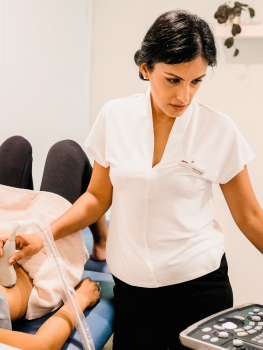 Treatment is built around your individual presentation. It typically includes:
- Manual therapy to address increased muscle tone and reduce tissue sensitisation
- Pelvic floor down-training: teaching the muscles to release, lengthen, and respond differently to penetration cues
- Graded exposure with vaginal trainers, introduced within a structured plan at a pace that is actually safe, not just technically possible
- Pain neuroscience education to address the nervous system’s learned protective response
- Breathing and relaxation strategies that directly reduce pelvic floor reactivity
- Kegel work introduced progressively, once tone is addressed, to support blood flow, mind-body connection, and long-term maintenance
- Partner involvement where relevant and appropriate
Early shifts are often felt within the first few sessions. Meaningful, durable change typically takes longer, and the timeline is individual. Complex or long-standing presentations will require more sessions to achieve lasting results. What the research consistently shows is that outcomes are significantly better when treatment addresses the full picture rather than the muscle alone.
You can read more about our approach on our pelvic pain and vaginismus page.
When should I see a physiotherapist if I have vaginismus and want to conceive?
Now. Not after you have tried everything else. Not after the next failed attempt. Now.
Women with vaginismus who want to conceive often spend years in a cycle of attempting intercourse, experiencing pain or failure, avoiding it, and carrying increasing shame and pressure. Every month that passes without a successful attempt becomes heavier. Starting treatment sooner shortens that cycle.
You do not need a referral to see a pelvic floor physiotherapist in Singapore. You can self-refer directly. If you are already working with a gynaecologist or fertility specialist, physiotherapy sits alongside that care.
Consider booking an assessment if:
- Penetrative sex is painful or not possible, and you are trying to conceive
- Using a tampon is difficult or impossible
- Smear tests are consistently painful, distressing, or you have been avoiding them
- A gynecologist has told you there is no structural explanation for your pain
- You have dilators at home that you cannot comfortably progress with
- You have been managing this alone and have not yet spoken to anyone about it
What happens after vaginismus is treated?
Resolving vaginismus is the beginning, not the end. Once penetrative sex is comfortable and possible, your focus shifts to conception and then to pregnancy itself.
 When pregnancy happens, your pelvic floor faces an entirely new set of demands. Preparing your body for birth, from managing pelvic floor function through pregnancy to getting ready for labour, is the natural next step. Our birth preparation service supports women through pregnancy and into labour with confidence.
The journey from vaginismus to parenthood is not always linear, and it is not always quick. But it is well-supported when you have the right team around you.
Ready to take the first step?
If you have been carrying this quietly, you do not have to any more. Book an assessment with the team at Embrace Physiotherapy and let us help you understand what is driving your symptoms and what to do next.
This blog was written by Preet Singh, women’s health physiotherapist and founder of Embrace Physiotherapy. It is for informational purposes only and does not constitute personal medical advice. Please seek assessment from a qualified healthcare professional.
References
Flores-Balcazar, C.H., Flores-Villalba, E., Martinez-Garza, J.H. et al. (2025) ‘Vaginismus treatment: a systematic review and meta-analysis of contemporary therapeutic approaches’, The Journal of Sexual Medicine, qdaf295. doi:10.1093/jsxmed/qdaf295.
Gupta, N.B. and Sajith, M. (2023) ‘Effectiveness of physical therapy interventions in women with dyspareunia: a systematic review and meta-analysis’, BMC Women’s Health, 23, 387. doi:10.1186/s12905-023-02532-8.
KK Women’s and Children’s Hospital / SingHealth (2018) ‘Sexual dysfunction in women’, SingHealth Medical News. Available at: https://www.kkh.com.sg/news/medical-news-singhealth/sexual-dysfunction-in-women (Accessed: March 2026).
Lahaie, M.A., Boyer, S.C., Amsel, R., Khalife, S. and Binik, Y.M. (2010) ‘Vaginismus: a review of the literature on the classification/diagnosis, etiology and treatment’, Women’s Health, 6(5), pp. 705-719. doi:10.2217/whe.10.46.
Maseroli, E., Scavello, I., Rastrelli, G. et al. (2018) ‘Outcome of medical and psychosexual interventions for vaginismus: a systematic review and meta-analysis’, The Journal of Sexual Medicine, 15(12), pp. 1752-1764. doi:10.1016/j.jsxm.2018.10.001.
Rosenbaum, T.Y. (2005) ‘Physiotherapy treatment of sexual pain disorders’, Journal of Sex and Marital Therapy, 31(4), pp. 329-340. doi:10.1080/00926230590950234.
van der Velde, J. and Everaerd, W. (2001) ‘The relationship between involuntary pelvic floor muscle activity, muscle awareness and experienced threat in women with and without vaginismus’, Behaviour Research and Therapy, 39(4), pp. 395-408. doi:10.1016/S0005-7967(00)00007-3.
Wang, Y., Chen, M., Liu, X. et al. (2024) ‘Trends and distribution of infertility in the Asia-Pacific region, 1990-2021’, China CDC Weekly, 6(28). doi:10.46234/ccdcw2024.155.
