
Surgery was supposed to be the answer. You waited, you advocated, you went through it, and you woke up on the other side still hurting.
We hear this regularly. And the first thing we want you to know is that persistent pain after endometriosis surgery is not a sign that something went wrong, that you are not healing properly, or that this is just how it is going to be.
Between 20 and 28% of women do not experience meaningful pain relief after laparoscopic surgery for endometriosis, even when the procedure is technically successful (Vanhie et al., 2021; De Corte et al., 2025). That is not a failure rate. It is a gap in how endometriosis is managed, and it is one that pelvic floor physiotherapy is well positioned to address.
Why does endometriosis take so long to diagnose in the first place?
 Most women arrive at surgery already carrying years of unmanaged pain. The global average diagnostic delay for endometriosis is 6.8 years, ranging from 1.5 to 11.4 years depending on where you live and who you see (Fryer et al., 2024). A prospective cohort of nearly 7,000 women in France found the average delay was 10 years for endometriosis and 11 years for adenomyosis (Letourneau et al., 2025). Delays are longest in women who first present with dysmenorrhoea because period pain is still routinely normalised, by clinicians and by women themselves (De Corte et al., 2025).
Those years matter. They are years in which the nervous system is adapting, the pelvic floor is bracing, and the brain’s pain processing is shifting. By the time surgery happens, the body has been living in a state of persistent pain for a long time. Surgery does not automatically undo that.
Does laparoscopic surgery for endometriosis work?
Yes, and it remains the most effective intervention for endometriosis-associated pain. A systematic review of 38 studies found meaningful pain relief after both excision and ablation, particularly in moderate to severe disease (Singh et al., 2020). For many women, surgery significantly reduces dysmenorrhoea, dyspareunia, and dyschezia.
What surgery cannot do is address the neurological changes that accumulate over years of persistent pain. For a substantial proportion of women, those changes are the primary driver of symptoms that continue after the procedure.
What is central sensitisation and why does it explain my ongoing pain?
Central sensitisation is what happens when your nervous system has been exposed to persistent pain for long enough that it starts processing things differently. The threshold for activating pain pathways lowers. Signals that would not normally register as painful begin to. Temporal summation, the way repeated stimuli produce a progressively stronger pain response, becomes exaggerated. The volume on pain stays turned up, even after the original source has been surgically removed (Zheng et al., 2019).
This is well documented in endometriosis. Research shows consistent evidence of altered central pain processing and widespread hyperalgesia in women with the condition, extending well beyond the pelvis (Zheng et al., 2019; McNamara et al., 2021). A 2023 prospective study in the American Journal of Obstetrics and Gynaecology found that pre-operative pelvic floor myalgia, painful bladder syndrome, bowel dysfunction, anxiety, and depression were all significantly associated with worse pain-related quality of life at 12 to 24 months after surgery, independent of what was found or done operatively (Tucker et al., 2023).
In other words, what was happening in the nervous system before surgery predicted outcomes more strongly than the surgery itself.
What is pelvic floor tension myalgia and how does it connect to endometriosis?
 The pelvic floor is a group of muscles at the base of the pelvis that supports the bladder, bowel, and uterus. In women with endometriosis, chronic inflammation and pain drive these muscles into a state of sustained overactivity, a condition called pelvic floor tension myalgia (Aredo et al., 2017).
Muscles with increased tone generate their own nociceptive input. Tender points develop and refer pain to the abdomen, low back, hips, inner thighs, and perineum. The bladder and bowel become sensitised. Sex becomes painful at entry, with penetration, or both. These are not symptoms of endometriosis lesions. They are symptoms of a pelvic floor that has been in protective overdrive for months or years, and they do not resolve when lesions are excised. You can read more about how we approach bladder and bowel symptoms here.
A 2024 RCT confirmed that women with deep infiltrating endometriosis show significantly reduced levator hiatus area at rest, an objective marker of chronic pelvic floor overactivity, and that pelvic floor physiotherapy produced measurable improvements in muscle function and patient-reported urinary, bowel, and sexual outcomes (Raimondo et al., 2024).
Sex is still painful. Is that something that can actually improve?
Yes. Dyspareunia that persists after surgery is most commonly driven by pelvic floor tension myalgia and central sensitisation, both of which are treatable.
An RCT by Del Forno et al. (2021) found significant reductions in superficial dyspareunia in women with deep infiltrating endometriosis following pelvic floor physiotherapy, with 3D transperineal ultrasound confirming objective improvements in pelvic floor muscle relaxation. A prospective cohort with 2-year follow-up found dyspareunia scores improved by 21mm on a visual analogue scale following multimodal physiotherapy, well above the 10mm minimum clinically important difference for endometriosis-associated pain (Dufour et al., 2023). A 2025 systematic review and meta-analysis confirmed localised pelvic floor physiotherapy as effective for endometriosis-associated pelvic pain across multiple domains (Gokce Can et al., 2025).
Waiting to see if things improve on their own is a reasonable first step in the weeks immediately after surgery. If painful sex is still present at 3 months post-operatively, that is a clear indication for assessment.
My bladder and bowels are still not right after surgery. Is that related?
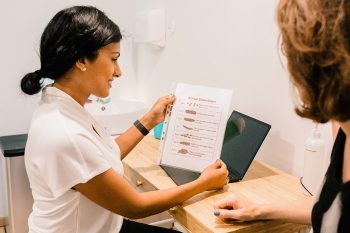 Almost certainly. Bladder urgency, painful urination, constipation, and pain with defecation are common in women with endometriosis, driven by a combination of direct disease involvement, pelvic floor overactivity, and central sensitisation affecting visceral afferent pathways (McNamara et al., 2021). Surgery addresses the structural contributions. It does not reset sensitised visceral pain processing or release pelvic floor muscles with increased tone. Our bladder and bowel control page explains more about how we assess and treat these symptoms.
The 2025 meta-analysis by Gokce Can et al. found physiotherapy effective across multiple endometriosis-associated pain domains including non-menstrual pelvic pain, with treatment benefits maintained at follow-up. Bladder and bowel retraining, pelvic floor down-training, and pain neuroscience education all have a role.
When should I see a pelvic floor physiotherapist after endometriosis surgery?
You do not need to wait until pain is severe or until everything else has failed. Consider booking an assessment if you have:
- pelvic pain that has not resolved, or only partially resolved, in the weeks to months after surgery
- pain with sex that was present before surgery and has not improved
- bladder or bowel symptoms including urgency, incomplete emptying, or pain with defecation, learn more on our bladder and bowel control page
- low back, hip, or tailbone pain that feels connected to your pelvis
In Singapore, you do not need a GP or specialist referral to access physiotherapy. You can self-refer directly. The evidence is clear that earlier intervention produces better outcomes. Women with more pre-operative pelvic pain comorbidities have significantly worse quality-of-life outcomes at 12 to 24 months post-surgery (Tucker et al., 2023). Starting sooner changes the trajectory.
What does physiotherapy for post-surgical endometriosis actually involve?
Endometriosis is a condition that requires whole-person, multidisciplinary management. Surgery, medical therapy, physiotherapy, psychological support, and nutrition each address different mechanisms, and the evidence for combined approaches is stronger than for any single intervention alone (Mick et al., 2024).
At Embrace Physiotherapy, we assess your full picture: pain history, pelvic floor function internally and externally, breathing, movement, bladder and bowel function, and sexual health. Nothing is off-limits. You can read more about our specific approach to endometriosis care here. Treatment is built around you, not a protocol. It typically includes:
- manual therapy to release pelvic floor tension, treat tender points, and address surgical scar tissue where relevant
- pelvic floor down-training for muscles with increased tone, with progressive loading introduced when the tissue is ready
- pain neuroscience education to address central sensitisation and reduce fear-avoidance behaviour
- bladder and bowel retraining as appropriate
- exercise prescription and flare management strategies for long-term resilience
Most women notice meaningful change within 4 to 6 sessions. Building durable improvement in pain, function, and quality of life takes longer, and the timeline is individual. The 2-year follow-up data from Dufour et al. (2023) shows that gains made through multimodal physiotherapy are sustained, without the need for further surgery or medical intervention. For more on the evidence behind our approach, read our blog: how physiotherapy can help endometriosis.
Endometriosis deserves comprehensive care
If this sounds like your experience, you do not have to keep managing it alone. Book an assessment with our team at Embrace Physiotherapy and let us help you work out what is driving your pain and what to do about it.
References
Aredo, J.V., Heyrana, K.J., Karp, B.I., Shah, J.P. and Stratton, P. (2017) ‘Relating chronic pelvic pain and endometriosis to signs of sensitization and myofascial pain and dysfunction’, Seminars in Reproductive Medicine, 35(2), pp. 88-97. doi:10.1055/s-0036-1597123.
De Corte, H., Meuleman, C., D’Hooghe, T. and Tomassetti, C. (2025) ‘Time to diagnose endometriosis: current status, challenges and regional characteristics: a systematic literature review’, BJOG: An International Journal of Obstetrics and Gynaecology, 132(3), pp. 294-386. doi:10.1111/1471-0528.17973.
Del Forno, S., Arena, A., Pellizzone, V., Lenzi, J., Orsini, L.F. and Seracchioli, R. (2021) ‘Assessment of pelvic floor muscles with 3D/4D transperineal ultrasound in women with deep infiltrating endometriosis and superficial dyspareunia treated with pelvic floor muscle physiotherapy: a randomised controlled trial’, Ultrasound in Obstetrics and Gynaecology, 59(1), pp. 108-116. doi:10.1002/uog.23590.
Dufour, S., Vandyken, B., Forget, M.J. and Vandyken, C. (2023) ‘The impact of multimodal physiotherapy in an interdisciplinary setting for the management of women with persistent pelvic pain and pelvic floor tension myalgia’, Physiotherapy Practice and Research, 44(2), pp. 66-71. doi:10.1080/21679169.2023.2188901.
Fryer, A., Shorvon, M., Rashid, T. and Heazell, A.E.P. (2024) ‘Understanding diagnostic delay for endometriosis: a scoping review using the social-ecological framework’, Health Care for Women International, 46(3). doi:10.1080/07399332.2024.2413056.
Gokce Can, G., Pinto Amorim das Virgens, I., Feher, B., Palma Orban, E., Fehervari, P., Banhidy, F., Hegyi, P., Mayer, A.A. and Acs, N. (2025) ‘Physiotherapy for endometriosis-associated pelvic pain: a systematic review and meta-analysis’, Pain Medicine, pnaf083. doi:10.1093/pm/pnaf083.
Letourneau, J., Fritel, X., Gaudineau, A., Lamau, M.C., Marcellin, L., Masson, R., Niro, J., Agostini, A. and Sibiude, J. (2025) ‘Endometriosis diagnostic delay and its correlates: results from the ComPaRe-Endometriosis cohort’, Journal of Women’s Health. doi:10.1177/15409996251380129.
McNamara, H.C., Frawley, H.C., Donoghue, J.F., Readman, E., Healey, M., Ellett, L., Reddington, C., Hicks, L.J., Harlow, K., Rogers, P.A.W. and Cheng, C. (2021) ‘Peripheral, central, and cross sensitization in endometriosis-associated pain and comorbid pain syndromes’, Frontiers in Reproductive Health, 3, 729642. doi:10.3389/frph.2021.729642.
Mick, I., Freger, S.M., van Keizerswaard, J., Gholiof, M. and Leonardi, M. (2024) ‘Comprehensive endometriosis care: a modern multimodal approach for the treatment of pelvic pain and endometriosis’, Therapeutic Advances in Reproductive Health, 18. doi:10.1177/26334941241277759.
Raimondo, D., Raffone, A., Maletta, M., Iodice, R., Virgilio, A., Schioppa, G., Borghese, G., Scambia, G. and Seracchioli, R. (2024) ‘Effects of pelvic floor muscle physiotherapy on urinary, bowel, and sexual functions in women with deep infiltrating endometriosis: a randomised controlled trial’, Medicina, 60(1), p. 67. doi:10.3390/medicina60010067.
Singh, S.S., Gude, K., Perdeaux, E., Gattrell, W.T. and Becker, C.M. (2020) ‘Surgical outcomes in patients with endometriosis: a systematic review’, Journal of Obstetrics and Gynaecology Canada, 42(7), pp. 881-888. doi:10.1016/j.jogc.2019.08.004.
Tucker, D.R., Noga, H.L., Lee, C., Chiu, D.S., Bedaiwy, M.A., Williams, C., Allaire, C., Talhouk, A. and Yong, P.J. (2023) ‘Pelvic pain comorbidities associated with quality of life after endometriosis surgery’, American Journal of Obstetrics and Gynaecology, 229(2), 147.e1-147.e20. doi:10.1016/j.ajog.2023.04.040.
Vanhie, A., Meuleman, C., Tomassetti, C., Timmerman, D. and D’Hooghe, T. (2021) ‘Systematic review of patient-specific pre-operative predictors of pain improvement to endometriosis surgery’, Human Reproduction Open, 2021(1), hoab004. doi:10.1093/hropen/hoab004.
Zheng, P., Zhang, W., Leng, J. and Lang, J. (2019) ‘Research on central sensitisation of endometriosis-associated pain: a systematic review of the literature’, Journal of Pain Research, 12, pp. 1447-1456. doi:10.2147/JPR.S197200.