
Your heels hurt in the morning. Your shoulder has been stiffening for months. Your knees ache going down stairs. Your fingers feel tight before you have even had a coffee.
You have Googled it. You have mentioned it to your GP. You have possibly been told it is wear and tear, stress, or just what happens as you get older.
Your body is not falling apart. It is responding to a hormonal shift that nobody warned you about.
Joint and muscle pain is the number one symptom of perimenopause among women in Singapore, ranking above hot flushes, sleep problems, and vaginal dryness. That is not an opinion. It is what the 2026 Singapore Guidelines on the Management of the Menopause Transition, launched at KK Women’s and Children’s Hospital, found when surveying 1,461 midlife women. 63.9% reported moderate to severe symptoms. Of those, 69.6% had never discussed their symptoms with a healthcare professional. What that tells us is that thousands of women in Singapore are managing significant pain and getting very little help. This blog is for them, and for you. It covers what is happening, why general treatment often falls short, and what a perimenopause and menopause physiotherapy approach actually looks like in practice.
Why does everything hurt in perimenopause?
Estrogen is not just a reproductive hormone. It is active throughout your entire musculoskeletal system. It regulates collagen production, keeps joints lubricated, controls inflammation, maintains cartilage, and supports muscle mass and recovery. When estrogen declines during perimenopause, all of those processes are affected at once.
A 2024 review published in Climacteric introduced the term ‘musculoskeletal syndrome of menopause’ to capture the full picture. The authors found that 70% of all midlife women will experience this syndrome, 25% will have severe symptoms, and 40% will have no structural findings on imaging at all. That last figure matters. It means that if you have had a scan and been told everything looks normal, that does not mean nothing is wrong. The changes are hormonal and systemic, not always visible on an MRI (Wright et al., 2024).
Here is what declining estrogen does to your body:
- Collagen production drops, making tendons, ligaments, and the plantar fascia less elastic and more prone to injury under normal loads.
- The anti-inflammatory effect estrogen normally provides is reduced, allowing low-grade inflammation to develop in joints and surrounding tissue.
- Joint lubrication decreases, increasing stiffness, particularly in the morning or after periods of rest.
- Cartilage metabolism changes as estrogen receptors in cartilage lose their stimulation. The risk of progressive wear increases.
- Muscle mass declines at approximately 0.6% per year after menopause, increasing the load placed on joints.
- Bone mineral density reduces by an average of 10% during perimenopause alone.
These changes do not happen in sequence. They happen simultaneously, across your whole body, over years. That is why the pain can feel so diffuse and so difficult to pin down.
Is plantar fasciitis linked to perimenopause?
Yes. The Search Console data for this website shows thousands of Singapore women searching for exactly this connection every month. If you are waking up with sharp heel pain that eases after your first few steps, this is worth reading carefully. Our detailed guide to plantar fasciitis and heel pain covers the condition in full, including exercises and treatment options. Here is the hormonal context that most treatment plans do not address.
The plantar fascia is a thick band of connective tissue running from the heel to the base of your toes. It is almost entirely collagen. When estrogen declines and collagen synthesis slows, the plantar fascia loses the elasticity it needs to absorb the impact of walking, standing, and exercise. Tissue that previously adapted without complaint now develops micro-tears and an inflammatory response at the heel.
This is why plantar fasciitis in a perimenopausal woman behaves differently to plantar fasciitis in a younger runner. The tissue quality is different. The recovery timeline is longer. And treating it purely as a mechanical overuse injury, without considering what is happening hormonally, is why so many women go through months of standard treatment without lasting results.
Is frozen shoulder connected to menopause?
In Chinese culture, frozen shoulder is sometimes called the 50-year-old shoulder. It is not a coincidence that this name exists, or that it specifically names the age at which so many women in Singapore experience it.
Frozen shoulder, or adhesive capsulitis, is a condition in which the shoulder joint capsule thickens, tightens, and restricts movement progressively over months. It is painful, it is slow, and it is twice as common in women as in men. It peaks between the ages of 40 and 60, precisely the perimenopausal window.
Research points to several mechanisms through which estrogen decline contributes. Estrogen receptors are present throughout the shoulder capsule and surrounding ligaments. When estrogen drops, the capsule becomes prone to the inflammatory changes and fibrosis that define the condition. Estrogen also regulates collagen metabolism and its anti-inflammatory function. Lose it, and you lose the protection the shoulder joint relied on (Wright et al., 2024; Saltzman et al., 2023).
A 2023 study from the Orthopaedic Journal of Sports Medicine found an association between hormone replacement therapy and reduced risk of adhesive capsulitis in menopausal women. It is not yet a treatment standard, but the biological signal is there.
Many women with frozen shoulder in perimenopause have already tried physiotherapy with limited success. Often this is because the shoulder is being treated as an isolated joint problem, not as a tissue sitting within a body undergoing significant hormonal change. The difference in outcome, when that context is understood and incorporated into treatment, is substantial.
What other joints are affected by estrogen decline?
According to Prof Yong Eu Leong of the National University Hospital, menopausal arthralgia is the most commonly reported health concern among midlife Singaporean women, with 64.4% wanting more information on it and one-third of the women in the NUH cohort reporting joint pain (Wong et al., 2024). Neck and knee pain are the most frequent presentations, followed by back pain, hands, and shoulder.
Beyond plantar fasciitis and frozen shoulder, estrogen decline affects:
- Knee joints: cartilage thinning and reduced joint fluid increase pain and stiffness, particularly with stairs and after prolonged sitting. Women are two to four times more likely than men to develop knee osteoarthritis, with onset accelerating around menopause.
- Hip joints: hip pain in perimenopause is often attributed to bursitis or tendinitis, both driven by the same inflammatory shift. The MARIE-Singapore qualitative study (KKH, 2025) documented a participant whose deep-seated hip pain resolved only after starting hormone replacement therapy.
- Hands and wrists: stiffness and aching in the fingers and wrists are common perimenopausal complaints, frequently dismissed as early arthritis. The mechanism is the same: reduced estrogen, altered cartilage metabolism, increased inflammation.
- Spine: lower back and neck pain often worsen in perimenopause. Spinal disc hydration and ligament laxity both have estrogen-mediated components.
If you are experiencing pain in multiple joints that feels out of proportion to your activity level, estrogen decline is the most likely shared cause. This is not a collection of separate problems. It is one hormonal shift, expressing itself across your body.
Ready to find out what’s actually going on?
If your pain has been building for months and you keep getting told everything looks normal, an assessment that takes your hormonal context seriously is a good next step.
What else could be causing your pain?
Estrogen decline is the most common driver of joint and muscle pain in perimenopause, but it is not always the only one. For treatment to work properly, the other contributing factors need to be on the table too. This is the root cause approach that women’s health physiotherapy is built around.
The following conditions are common in midlife women, frequently overlap with perimenopausal symptoms, and are regularly missed at the GP level:
- Thyroid dysfunction: hypothyroidism is particularly prevalent in women aged 40 to 60. It causes joint pain, fatigue, carpal tunnel-like symptoms, and weight changes that closely mirror perimenopausal symptoms. A TSH blood test will identify it. If this has not been checked, it is worth asking.
- Vitamin D deficiency: more common in Singapore than many women expect, despite year-round sun. Indoor working, consistent sunscreen use, and limited midday exposure all contribute. Low vitamin D causes bone and muscle pain that mimics inflammatory joint disease. It is also directly linked to the musculoskeletal syndrome of menopause (Wright et al., 2024).
- Vitamin B12 deficiency: more prevalent in women following plant-based diets, or those on long-term metformin for blood sugar management. Causes nerve pain, tingling, fatigue, and muscle weakness that can look exactly like musculoskeletal injury.
- Iron deficiency: heavier or more irregular periods are common in perimenopause, and iron deficiency follows. Fatigue and muscle weakness increase joint load and raise injury risk.
- Autoimmune conditions: rheumatoid arthritis and related autoimmune joint conditions peak in women in their late 40s, likely linked to the shift in immune regulation around estrogen decline. If joint pain is symmetrical, involves warmth or swelling, or is present for more than an hour on waking, this needs investigation.
- Hypermobility: some women have managed joint hypermobility well for years, supported by good muscle tone. As estrogen declines and that muscular protection reduces, previously manageable hypermobility can become symptomatic and painful.
Identifying these factors changes the treatment plan. A physiotherapist who only looks at the joint achieves limited results when the real driver is thyroid, nutritional, or systemic. This is why assessment in perimenopause needs to be a conversation, not just a movement screen.
Why does general physiotherapy not always work for perimenopausal joint pain?
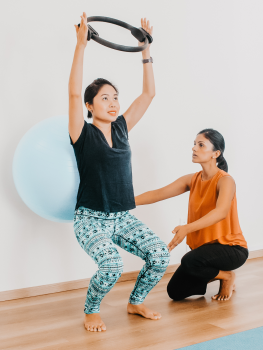 Many women going through perimenopause have already tried physiotherapy. It helped a little, or it did not help at all. This is not a failure of physiotherapy. It is a limitation of applying a protocol designed for a local injury to a systemic hormonal condition.
Standard musculoskeletal physiotherapy works like this: you have pain in a joint or tendon, the cause is mechanical overload or injury, the treatment targets the local tissue. Strengthen the calf. Stretch the plantar fascia. Mobilise the shoulder. For a 25-year-old with an acute sports injury, this is exactly right.
For a 47-year-old woman whose heel pain, stiff shoulder, and achy knees are all expressions of the same estrogen-driven process, in tissue that is simultaneously losing collagen, muscle mass, and anti-inflammatory protection, it is not enough. And the research backs this up. The same Wright et al. 2024 review that introduced the musculoskeletal syndrome of menopause was explicit in criticising the clinical habit of telling perimenopausal women that slowing down is normal and that ageing explains their pain. It does not.
The 2026 Singapore Guidelines on the Management of the Menopause Transition directly name physiotherapy as part of the recommended multidisciplinary care model, specifying musculoskeletal strengthening, weight-bearing exercise, and bone health monitoring as key components. This is not generic physio. It is informed, hormonally aware rehabilitation.
What does women’s health physiotherapy offer that is different?
At Embrace Physiotherapy in Katong, we treat perimenopausal joint pain as a whole-body, hormonally informed condition. Here is what that means for you:
We assess through a perimenopausal lens. Plantar fasciitis, frozen shoulder, and knee pain in a woman in her mid-40s are not the same presentations as in a younger patient. The tissue quality, the recovery timeline, and the contributing factors are different. Our assessment reflects that.
We look at the full load picture. How much are you doing, and is that load appropriate for where your tissue resilience is right now? Are you compensating in patterns that are shifting stress onto other joints? What does your pelvic floor do when you load your lower limb?
We include pelvic floor function as part of musculoskeletal assessment. The pelvic floor, hip, lower back, and lower limb work as an integrated system. Changes in pelvic floor tone during perimenopause affect the whole chain. Our overactive pelvic floor blog explains this connection in more detail.
We work within your broader clinical picture. If thyroid function, nutritional deficiencies, or autoimmune conditions have not been investigated, we will flag this and support you in getting the right referrals. Physiotherapy produces better outcomes when it is one part of a coordinated approach.
This is the distinction that matters. Most physiotherapy treats the symptom. Women’s health physiotherapy treats the woman.
When should I see a physiotherapist about joint pain in perimenopause?
Earlier than most women do. In Singapore, 64.4% of midlife women say they want more information about joint and muscle symptoms, yet most wait until pain is significantly disrupting daily life before seeking help (Wong et al., 2020).
You do not need to wait until you cannot walk to work or cannot lift your arm above your head. Earlier assessment means a shorter, more targeted programme and better long-term outcomes.
Come and see us if any of this sounds familiar:
- Heel or foot pain worst in the first steps of the morning.
- Shoulder pain or stiffness building gradually over weeks or months.
- Joint pain in multiple sites that feels out of proportion to what you are doing.
- Pain that has not responded to standard physiotherapy, rest, or anti-inflammatories.
- You are in your 40s or 50s, your body feels different to how it used to, and nobody has connected it to perimenopause.
Joint pain in perimenopause is common. It is not inevitable, and it is not something you have to endure. The 2026 Singapore national guidelines confirm that physiotherapy is part of the recommended care pathway for musculoskeletal symptoms in the menopause transition. You just need the right kind.
Ready to take the first step?
If your joints have been hurting for months and nothing has worked, it is time for an assessment that actually looks at the full picture.
This blog was written by Preet Singh, women’s health physiotherapist and founder of Embrace Physiotherapy. It is for informational purposes only and does not constitute personal medical advice. Please seek assessment from a qualified healthcare professional.
References
- Logan, S., Wong, B. W. X., Tan, J. H. I., Kramer, M. S., & Yong, E. L. (2023). Menopausal symptoms in midlife Singaporean women: prevalence rates and associated factors from the Integrated Women’s Health Programme (IWHP). Maturitas, 178, 107853.
- Wong, B. W. X., Chan, Y. H., Logan, S., Kramer, M. S., & Yong, E. L. (2024). Arthralgia in midlife Singaporean women: the Integrated Women’s Health Program (IWHP). Climacteric, 27(2), 178-186.
- Wong, J. L. J., Thu, W. P. P., Lim, C. W., Wang, Y. L., Yong, E. L., & Logan, S. J. S. (2020). Health information needs of 1000 midlife Singaporean women. Climacteric, 23(5), 511-518.
- Wright, V. J., Schwartzman, J. D., Itinoche, R., & Wittstein, J. (2024). The musculoskeletal syndrome of menopause. Climacteric, 27(5), 466-472.
- Quah, P. L., Puvanendran, R., Lulla, D., Husain, F. S., Lee, J. J. M., Ang, S. B., & Tan, K. H. (2026). Menopausal health in Singapore: a survey of women’s menopause-specific quality of life, and knowledge, attitudes, and practices among women and healthcare professionals. Singapore Journal of Obstetrics & Gynaecology, 57(1). Presented at IPRAMHO International Meeting, 20 February 2026, Singapore.
- Singapore Guidelines on Management of Menopause Transition Workgroup. (2026). Clinical guidelines for management of the menopause transition in Singapore: consensus statements. College of Family Physicians Singapore and College of Obstetricians and Gynaecologists, Singapore.
- Puvanendran, R., & Tan, K. H. (2026). Advancing menopausal health outcomes in Singapore: a population health imperative. Singapore Journal of Obstetrics & Gynaecology, 57(1). Presented at IPRAMHO International Meeting, 20 February 2026, Singapore.
- Saltzman, E., et al. (2023). Poster 188: Is hormone replacing therapy associated with reduced risk of adhesive capsulitis in menopausal women? A single centre analysis. Orthopaedic Journal of Sports Medicine.
- Aggarwal, I. M., Aiyappan, R., Husain, F. S., et al. (2025). Navigating menopause in Singapore: sociocultural, clinical, and policy implications from a qualitative study (MARIE-Singapore). Preprints.org. doi: 10.20944/preprints202511.2010.v1.
- GoodRx Health. (2024). Frozen shoulder and menopause: is there a connection? Retrieved from goodrx.com.
