
That sharp pain when you take your first steps in the morning. The feeling of walking on glass that eases as the day gets going, then comes back after you have been sitting for a while.
If you are a woman in your 40s or 50s and this sounds familiar, you are not imagining it, and it is not just bad footwear. Plantar fasciitis is one of the most common musculoskeletal conditions in perimenopausal women, and estrogen decline is a significant reason why.
This blog covers what plantar fasciitis is, what causes it, what else could be behind your heel pain, and what to do about it. If you want to understand the full hormonal picture behind why perimenopausal women are so much more susceptible to heel pain, frozen shoulder, and joint aching across the board, we have written a detailed guide to that too.
Is your heel pain part of a bigger picture?
Plantar fasciitis in perimenopause does not happen in isolation. Estrogen decline affects your joints, tendons, muscles, and bones simultaneously. If you are also experiencing a stiff shoulder, aching knees, or joint pain across multiple sites, our guide Why do my joints ache in perimenopause? explains what is happening and what women’s health physiotherapy can do about it.
What is plantar fasciopathy?
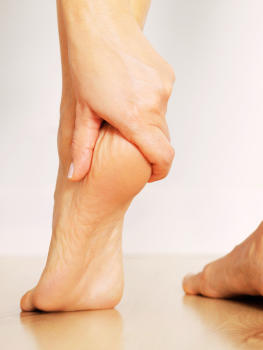 The plantar fascia is a broad band of fibrous connective tissue running from your heel bone to the base of your toes. It supports the arch of your foot and absorbs the force of walking, standing, and exercise.
When this tissue is overloaded or loses its elasticity, micro-tears develop at the heel attachment, causing the inflammation and pain we call plantar fasciitis or plantar fasciopathy. The two terms are often used interchangeably. Fasciopathy is the more accurate clinical term as it reflects the degenerative process involved, not just inflammation.
The pain is typically worst first thing in the morning because the fascia tightens overnight. Once you start moving, it warms and lengthens, which is why symptoms usually ease after your first few minutes on your feet, then return after long periods of sitting.
Can menopause cause plantar fasciitis?
Estrogen plays a direct role in collagen production. Collagen is the structural protein that gives the plantar fascia its strength and flexibility. When estrogen declines in perimenopause, collagen synthesis slows. The plantar fascia becomes stiffer, less elastic, and less able to adapt to everyday demands.
This is a whole-body change, not a local foot problem. A 2024 review published in Climacteric introduced the term ‘musculoskeletal syndrome of menopause’ and found that 70% of midlife women experience this syndrome, 25% will have severe symptoms, and 40% will have no structural findings on imaging at all. Normal scans, real pain (Wright et al., 2024). The full picture of how estrogen affects joints, tendons, and bones across the body is in our guide to perimenopause and musculoskeletal pain.
Other factors that increase the risk of plantar fasciitis include:
- Being a woman between 40 and 60.
- A sudden increase in weight-bearing activity or exercise intensity.
- Weight gain, including during pregnancy.
- Tight calf muscles or reduced ankle mobility.
- High or low foot arch.
- Footwear without adequate arch support or cushioning.
- Prolonged standing on hard surfaces.
In perimenopausal women, plantar fasciitis often develops gradually without any obvious trigger. The tissue changes happening hormonally in the background are enough.
Could it be something other than plantar fasciitis?
Plantar fasciitis is the most common cause of heel pain, but it is not the only one. Several other conditions produce similar symptoms and are regularly misdiagnosed, particularly in women who have not responded to standard treatment. Getting the right diagnosis is the most important step, because the wrong treatment for the wrong condition rarely works.
Here are the conditions most commonly mistaken for plantar fasciitis:
Baxter’s nerve entrapment
This is the most frequently missed diagnosis in women with chronic heel pain. Baxter’s nerve is the first branch of the lateral plantar nerve. When it becomes compressed, it produces heel pain that closely mimics plantar fasciitis but behaves differently. A key distinguishing feature: the pain is not worst in the morning. Instead, it builds as the day progresses and worsens with prolonged weight-bearing. It may also have a burning or tingling quality. Research suggests Baxter’s nerve entrapment accounts for up to 20% of chronic heel pain cases (Kaur et al., 2024). If your heel pain has not responded to standard plantar fasciitis treatment, this is worth investigating.
Tarsal tunnel syndrome
Tarsal tunnel syndrome is compression of the posterior tibial nerve as it passes through the tarsal tunnel on the inner ankle. It produces burning, tingling, or shooting pain into the heel, arch, or toes, and may worsen at night or with prolonged standing. It is often confused with plantar fasciitis and can coexist with it, which is one of the reasons some cases of heel pain are so difficult to resolve with standard treatment alone.
Calcaneal stress fracture
A stress fracture of the heel bone produces pain that is present throughout the day and worsens with any weight-bearing activity, not just the first steps in the morning. This is a particularly important differential in perimenopausal women, because declining estrogen accelerates bone density loss. A woman in her late 40s presenting with heel pain after a low-impact activity such as walking, without a clear overuse trigger, warrants consideration of bone health before high-load strengthening is prescribed. Imaging is needed to confirm.
Heel fat pad atrophy
The fat pad under the heel acts as a shock absorber. As estrogen declines and fatty tissue quality changes with age, the pad can thin and lose its cushioning function. The pain is a deep, aching discomfort felt directly under the heel rather than at the front edge where plantar fasciitis typically presents. This is more common than it is diagnosed.
S1 radiculopathy
Referred pain from the lower back, specifically from the S1 nerve root, can travel into the heel and be mistaken for plantar fasciitis. If your heel pain is accompanied by lower back pain, pain radiating down the back of the leg, or any numbness or tingling, a spinal assessment is needed. Treating the heel alone will not resolve pain that originates in the spine.
Systemic and inflammatory arthritis
Rheumatoid arthritis, psoriatic arthritis, and reactive arthritis can all cause heel pain, often at the attachment point of the plantar fascia or Achilles tendon. If your heel pain is accompanied by other joint symptoms, prolonged morning stiffness across multiple joints, or skin or nail changes, a rheumatology referral and blood work may be more appropriate than physiotherapy as a first step.
If you have been treated for plantar fasciitis and are not improving, the most valuable thing you can do is see someone who will reassess the diagnosis, not simply escalate the same treatment.
What can be done about plantar fasciitis?
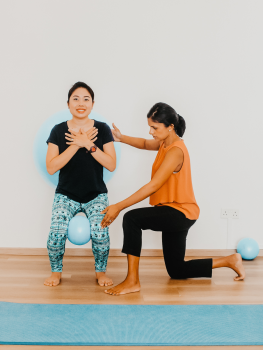
The 2023 Heel Pain Clinical Practice Guideline from the Academy of Orthopaedic Physical Therapy, which reviewed 64 meta-analyses and 126 systematic reviews, confirmed that therapeutic exercise including resistance training is the cornerstone of conservative management (Martin et al., 2023). Treatment depends on which phase you are in.
- Load management
- Avoid walking barefoot, especially on hard floors first thing in the morning.
- Reduce prolonged standing where possible.
- Temporarily modify high-impact activity. Cycling, swimming, and aqua jogging keep you active without overloading the heel.
- Pace activity throughout the day rather than alternating between long rest and bursts of effort.
- Footwear
- Cushioned soles with good arch support make a meaningful difference to daily symptoms.
- A small heel raise is often more comfortable than completely flat shoes.
- Heel pads or gel cups inside existing footwear reduce impact at the attachment site.
- Cold therapy
- Rolling the foot over a frozen water bottle from toe to heel for 5 to 10 minutes reduces local inflammation and provides short-term relief.
- Stretching
- Calf stretching and plantar fascia stretching are well-evidenced starting points. Your physiotherapist will guide you on technique and frequency.
- Strengthening
- Progressive strengthening of the calf and foot is essential for lasting resolution. High-load strength training, including single-leg heel raises with progressive load, produced superior outcomes to stretching alone at 3 months in a landmark RCT (Rathleff et al., 2014).
- The 2023 Clinical Practice Guideline also supports dry needling to the gastrocnemius, soleus, and plantar muscles for short and long-term pain reduction (Martin et al., 2023).
- In perimenopausal women, this strengthening programme needs to be more graduated and allow a longer timeline. Tissue that has lost estrogen-mediated resilience recovers more slowly. Stopping treatment when pain eases rather than when strength is fully restored is the most common reason plantar fasciitis returns.
- Extracorporeal shockwave therapy (ESWT)
- For cases that have not resolved with conservative management, ESWT has the strongest evidence of any adjunct intervention. A 2023 systematic review and meta-analysis of 236 studies involving 15,401 patients found ESWT was the only intervention consistently effective for medium and long-term pain reduction beyond the short term (Guimaraes et al., 2023).
- Injections
- Corticosteroid injections may reduce inflammation in the short term but a 2024 meta-analysis of 17 RCTs (1,109 subjects) found no significant effect on plantar fascia thickness or pain relief above active controls (Pena-Martinez et al., 2024). They are not a first-line option and do not address the underlying cause.
- Platelet-rich plasma (PRP) is emerging as a more durable alternative. A 2025 meta-analysis of 24 RCTs (1,653 participants) found PRP produced significantly better pain scores than corticosteroids at 3 and 6 months. It may be worth discussing with your specialist for resistant cases.
- Other options
- Taping: offloads the plantar fascia during the pain-dominant phase.
- Podiatry: useful for custom orthotics if foot posture is a contributing factor.
- Anti-inflammatories: helpful short-term for pain management. Do not address the underlying cause.
- Surgery: rarely required, only after exhaustive conservative treatment.
Not sure which treatment is right for where you are now?
A structured assessment will tell you what phase you are in, what is driving the problem, and what programme is appropriate for your body right now.
Does seeing a women’s health physiotherapist make a difference?

Yes. But not because women’s health physiotherapists follow a different exercise protocol. It is because the assessment is different.
Most physiotherapy for plantar fasciitis starts with the heel. A women’s health assessment starts with you. That sounds like marketing language, so let me be specific about what it actually means in practice.
The first thing we do is question the diagnosis. Plantar fasciitis is the most common cause of heel pain, but as the section above explains, it is not the only one. Baxter’s nerve entrapment, tarsal tunnel syndrome, a calcaneal stress fracture, and referred pain from the lumbar spine all produce symptoms that look similar on the surface. If you have been through multiple rounds of calf strengthening and stretching without lasting improvement, there is a reasonable chance the treatment has been right but the diagnosis has not. Getting that wrong first is the most common reason heel pain becomes a years-long problem.
The second thing is understanding where your tissue actually is right now. A perimenopausal woman’s plantar fascia is not the same as a 30-year-old runner’s. The collagen quality is different. The recovery timeline is longer. A high-load programme that would be appropriate for a younger patient can cause a significant flare in someone whose tissue resilience has changed hormonally. We calibrate load to where you are, not where you were five years ago, and we progress more gradually because that is what produces lasting results.
If you are in perimenopause and your heel pain started after something low-impact, we will raise bone density as a question before prescribing high-load exercise. A calcaneal stress fracture in a woman with declining bone density does not need more heel raises. It needs imaging and a different plan.
We also look at the whole lower limb, not just the foot. The way force moves through the heel and ankle is affected by pelvic floor tone, hip function, and core stability. Changes in pelvic floor tone during perimenopause alter the entire chain, shifting stress onto the heel and ankle in ways that standard biomechanical assessment does not capture. Our overactive pelvic floor blog explains this connection in more detail.
And if your thyroid function, vitamin D, or iron levels have never been checked, we will flag it. Not because physiotherapy fixes nutritional deficiencies, but because the right referral at the right time means the programme we build together will actually work.
Most physiotherapy treats the symptom. Women’s health physiotherapy treats the woman.
When should I see a physiotherapist about heel pain?
Earlier than most women do. Come and see us if:
- Your heel pain has been present for more than 6 weeks without clear improvement.
- It keeps returning after periods of settling.
- Standard treatment has not given you lasting results.
- Your pain worsens through the day rather than being worst in the morning.
- You have burning, tingling, or shooting sensations in the heel or foot.
- You are also experiencing joint pain, stiffness, or muscle aching elsewhere.
- You are in your 40s or 50s and want to understand what your hormonal changes mean for how you train, recover, and manage your body long term.
If your heel pain has not responded to rest or standard treatment, it is time for an assessment that looks at the full picture.
This blog was written by Preet Singh, women’s health physiotherapist and founder of Embrace Physiotherapy. It is for informational purposes only and does not constitute personal medical advice. Please seek assessment from a qualified healthcare professional.
References
-
- Rathleff, M. S., Molgaard, C. M., Fredberg, U., et al. (2014). High-load strength training improves outcome in patients with plantar fasciitis: a randomized controlled trial with 12-month follow-up. Scandinavian Journal of Medicine and Science in Sports, 25(3), e292-e300.
- Martin, R. L., et al. (2023). Heel pain — plantar fasciitis: revision 2023. Journal of Orthopaedic and Sports Physical Therapy, 53(12), CPG1-CPG19.
- Guimaraes, J. S., Arcanjo, F. L., Leporace, G., et al. (2023). Effects of therapeutic interventions on pain due to plantar fasciitis: a systematic review and meta-analysis. Clinical Rehabilitation, 37(6), 727-746.
- Pena-Martinez, V. M., Acosta-Olivo, C., Simental-Mendia, L. E., et al. (2024). Effect of corticosteroids over plantar fascia thickness in plantar fasciitis: a systematic review and meta-analysis. The Physician and Sportsmedicine, 52(3), 217-228.
- Platelet-rich plasma versus corticosteroids in plantar fasciitis: a meta-analysis of 24 RCTs (1,653 participants). (2025). American Journal of Physical Medicine and Rehabilitation.
- Wright, V. J., Schwartzman, J. D., Itinoche, R., & Wittstein, J. (2024). The musculoskeletal syndrome of menopause. Climacteric, 27(5), 466-472.
- Kaur, H., Tiwari, P., & Bansal, N. (2024). Baxter’s nerve entrapment: the hidden culprit of chronic heel pain. Archives of Medicine and Health Sciences, 12(2), 284-285.
- Logan, S., Wong, B. W. X., Tan, J. H. I., Kramer, M. S., & Yong, E. L. (2023). Menopausal symptoms in midlife Singaporean women: prevalence rates and associated factors from the Integrated Women’s Health Programme (IWHP). Maturitas, 178, 107853.
- Singapore Guidelines on Management of Menopause Transition Workgroup. (2026). Clinical guidelines for management of the menopause transition in Singapore. College of Family Physicians Singapore and College of Obstetricians and Gynaecologists, Singapore.
- StatPearls. (2024). Plantar heel pain. National Center for Biotechnology Information. Retrieved from ncbi.nlm.nih.gov/books/NBK499868.
