
If you have a prolapse, you have probably been told to be careful. Stop lifting. Avoid impact. Take it easy. Maybe a friend, a quick search, or even a clinician told you that exercise could make things worse.
Here is what most women are never told. The fear of exercise with a prolapse is far bigger than the evidence behind it. Some of the best research points the other way. Staying active may protect your pelvic floor, and avoiding exercise may carry its own risks.
Prolapse is common in Singapore. Around 1 in 3 midlife women here report symptoms of it (Yong et al., 2024). Many of them quietly give up the exercise they love, believing it is the safe thing to do. Often, it is not. Let me walk you through what the research actually shows, and who it studied, so you can see the full picture.
Can exercise make a prolapse worse?
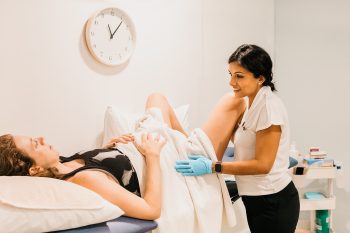 For most women, there is no good evidence that it does. That is the headline. Now the detail.
The theory goes like this. When you exert yourself, whether lifting a heavy bag, coughing, or landing during a run, the pressure inside your abdomen rises. The worry is that this pressure pushes down on the pelvic floor and gradually worsens a prolapse.
It is a reasonable theory. The evidence does not cleanly support it. When researchers reviewed 38 studies on physical activity and prolapse, covering a wide range of women and activity types, the picture was genuinely mixed. Many found no link at all. The current expert consensus is that there is not enough evidence to recommend for or against any particular type of exercise (Bo et al., 2022).
There is more. When one study measured the actual pressure generated inside the abdomen in over 500 women, that pressure showed no clear link to bladder or uterine prolapse (Tan et al., 2022). The simple story that more pressure equals more prolapse does not hold up.
So the confident advice to “avoid lifting” or “stop running” is not backed by strong research. The accurate answer is that it depends on the woman, her pelvic floor, and her symptoms. That is why an assessment matters more than a blanket rule.
Is it safe to exercise with a prolapse?
For most women, yes. And here is what surprises people. Not exercising may be the bigger risk.
A survey of nearly 4,000 women who already exercised found that those who did no lifting had a higher rate of prolapse symptoms than women who lifted heavy weights regularly. The inactive women were more than twice as likely to report symptoms than the heavy lifters (Forner et al., 2020). This was a snapshot in time, not a study that followed women for years, so it cannot prove exercise prevents symptoms, and some women may have been less active because of symptoms they already had. Even so, it does not support the idea that exercise causes harm.
Stronger evidence comes from a landmark trial of women recovering from prolapse surgery. One group was told to rest and avoid lifting and impact for three months. The other was told to return to activity at their own pace, with no restrictions. The women who stayed active reported fewer prolapse symptoms, not more (Mueller et al., 2017). That finding applies to women after surgery specifically, but it challenges the assumption that rest is always safer.
The benefits of exercise reach far beyond the pelvic floor. Your heart, your bones, your bowels, your mood, your sleep. Staying strong and active supports all of it. The cost of avoiding exercise is real, and it is too often left out of the conversation.
Worried your favourite workout is off limits?
If a prolapse has you second-guessing every squat and every run, an assessment can show you what is actually safe for your body.
Can I lift weights with a prolapse?
Yes. And the research here is genuinely reassuring.
In that survey of nearly 4,000 active women, the heavy lifters had the lowest rate of prolapse symptoms of any group. Around 7% of women lifting over 50kg reported symptoms, compared to 21% of the inactive women (Forner et al., 2020). Lifting heavy did not appear to harm the pelvic floor. These women were already lifting, so the study cannot tell us how a complete beginner would respond. What it does show is that heavy lifting and a healthy pelvic floor clearly go together.
What matters is not the size of the weight. It is how your body manages the moment of effort. A few principles make the difference:
- The Knack. This is a gentle, well-timed pelvic floor contraction just before you lift. Done well, it gives your pelvic organs support at the exact moment of load. It is one of the most useful skills we teach.
- Breathing. Holding your breath and bearing down at the same time is the combination to avoid. Learning to breathe through effort, rather than strain against it, changes everything.
- Building gradually. Start within your capacity and progress over time. This is sound strength training and sound pelvic floor care at once.
- Form first. Good technique reduces unnecessary pressure far more than simply lifting lighter does.
You do not have to give up strength training. You have to learn to do it in a way your pelvic floor can support.
Can I run with a prolapse?
 Yes, and many women do. This is simply the one form of exercise where it pays to listen to your body a little more closely.
Here is why. Lifting involves a few big efforts in a session. Running involves thousands of small impacts, one with every stride. That volume is the reason running is the activity most likely to bring on symptoms. In a survey comparing women who ran with women who did heavier, strength-based training, the runners reported more heaviness and bulging (Forner et al., 2021). Both groups were already active and similar in age and birth history, so this was a fair comparison between two kinds of exercise, not exercise versus rest. As a snapshot survey, it cannot prove running caused the symptoms, but the pattern is consistent and worth respecting.
So running is the activity to stay most symptom-aware with. The simple guide is this. Heaviness, dragging, or a bulging sensation during or after a run is meaningful feedback from your body. If symptoms climb with distance or speed, that is the signal to adjust, not to stop for good.
Plenty of women return to running with a prolapse and stay symptom free. It often comes down to building the right foundation first, pelvic floor strength, control, and a gradual return rather than straight back to old distances. This is the kind of return we guide women through every week.
What exercises should I avoid with a prolapse?
There is no universal avoid list, and any advice that hands you one is going beyond what the evidence supports.
When researchers searched for studies on exercises that worsen prolapse, they found very few, and the ones that existed were in women recovering from surgery rather than everyday active women (Bo et al., 2022). A review of lifestyle and prolapse reached the same place. The strategies often recommended to women are sensible for general health, but cannot be said with confidence to change prolapse itself (Jeppson et al., 2025). There is no strong evidence that any specific exercise reliably harms the pelvic floor across all women.
What we work with instead are principles. A few categories are worth assessing rather than avoiding outright:
- Repetitive high impact at volume, like long runs or repeated jumping, especially if it brings on heaviness or bulging.
- Heavy efforts done with a held breath and a downward bearing strain, with no pelvic floor activation.
- Abdominal exercises that push down rather than draw up, particularly in the early stages of recovery.
Notice the pattern. It is rarely the exercise itself. It is how it is done, and whether your pelvic floor is working with you in the moment. The same movement that troubles one woman is fine for another. A list is the wrong tool. An assessment is the right one.
Could my symptoms be something other than a prolapse?
Yes, and it is worth ruling out before you change a single thing about your training. Not every feeling of heaviness or bulging is a prolapse.
A tight or overactive pelvic floor can produce very similar sensations, particularly after exercise, and it needs close to the opposite treatment. Straining, pressure, and dragging can also come from bladder or bowel habits rather than the organs themselves. Around menopause, falling estrogen can leave tissues feeling more sensitive and irritated, with no change in support at all.
This is why we assess before we advise. Treating the wrong problem costs you months of effort. Getting the right diagnosis first is the shortest path back to the exercise you love.
Not sure whether this applies to you?
If you have been given a diagnosis and no real plan, or told to avoid exercise with no explanation of why, our prolapse page walks through exactly what care involves.
How does physiotherapy help me exercise with a prolapse?
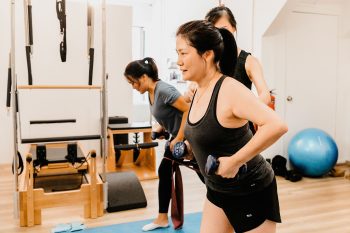 The goal is never a list of things you cannot do. It is to build a body you can trust, and the knowledge to move well. Here is what that looks like at Embrace Physiotherapy in Singapore:
- We assess first. Your pelvic floor function, your symptoms, and the kind of activity you want to get back to. We cannot guide what we have not looked at.
- We teach the Knack and breathing strategies, so your pelvic floor supports you at the moment of effort.
- We build load gradually, growing your capacity for lifting, running, or whatever you love, at a pace your body can handle.
- We use your symptoms as the guide, setting a clear threshold so you know when to push and when to ease off.
- We replace fear with understanding, so you are not avoiding exercise unnecessarily and missing out on everything it gives you. Our clinical rehabilitation classes are one way women build this confidence in a supported setting.
If you have been holding back from the gym, the trail, or the class you love because of a prolapse, you may have more freedom than you have been told. The right guidance helps you find it safely. You can read about how prolapse behaves at every life stage, or what physiotherapy looks like before and after prolapse surgery.
Move with confidence
Your prolapse does not have to be the end of an active life. For most women in Singapore, the right kind of exercise is part of the answer, not something to fear. Book an appointment at Embrace Physiotherapy in Katong, and let us build a plan that gets you back to what you love.
This blog was written by Preet Singh, women’s health physiotherapist and founder of Embrace Physiotherapy. It is for informational purposes only and does not constitute personal medical advice. Please seek assessment from a qualified healthcare professional.
References
Bo, K., Angles-Acedo, S., Batra, A., Braekken, I.H., Chan, Y.L., Jorge, C.H., Kruger, J., Yadav, M. and Dumoulin, C. (2022) ‘International urogynecology consultation chapter 3 committee 2: conservative treatment of patient with pelvic organ prolapse: pelvic floor muscle training’, International Urogynecology Journal, 33(10), pp. 2633-2667.
Forner, L.B., Beckman, E.M. and Smith, M.D. (2020) ‘Symptoms of pelvic organ prolapse in women who lift heavy weights for exercise: a cross-sectional survey’, International Urogynecology Journal, 31(8), pp. 1551-1558.
Forner, L.B., Beckman, E.M. and Smith, M.D. (2021) ‘Do women runners report more pelvic floor symptoms than women in CrossFit? A cross-sectional survey’, International Urogynecology Journal, 32(2), pp. 295-302.
Jeppson, P.C., Balgobin, S., Wheeler, T., Forner, L., Caagbay, D., Thompson, J., Muffly, T.M., Meyer, I., Beestrum, M., Collins, S. and Sung, V. (2025) ‘Impact of lifestyle modifications on the prevention and treatment of pelvic organ prolapse’, International Urogynecology Journal, 36(1), pp. 59-69.
Mueller, M.G., Lewicky-Gaupp, C., Collins, S.A., Abernethy, M.G., Alverdy, A. and Kenton, K. (2017) ‘Activity restriction recommendations and outcomes after reconstructive pelvic surgery: a randomized controlled trial’, Obstetrics and Gynecology, 129(4), pp. 608-614.
Tan, J.M., Dietz, H.P. and Shek, K.L. (2022) ‘The repeatability of measurement of effort during Valsalva and its impact on pelvic organ descent’, International Urogynecology Journal, 33(9), pp. 2453-2458.
Yong, E.L., Wong, B.W.X., Shen, L., Hong, E.Y., Cheong, C.W., Kramer, M.S. and Ng, R. (2024) ‘Prevalence and incidence of pelvic organ prolapse, bowel and urinary dysfunction in the Integrated Woman’s Health Program’, Maturitas, 189, 108106.
